
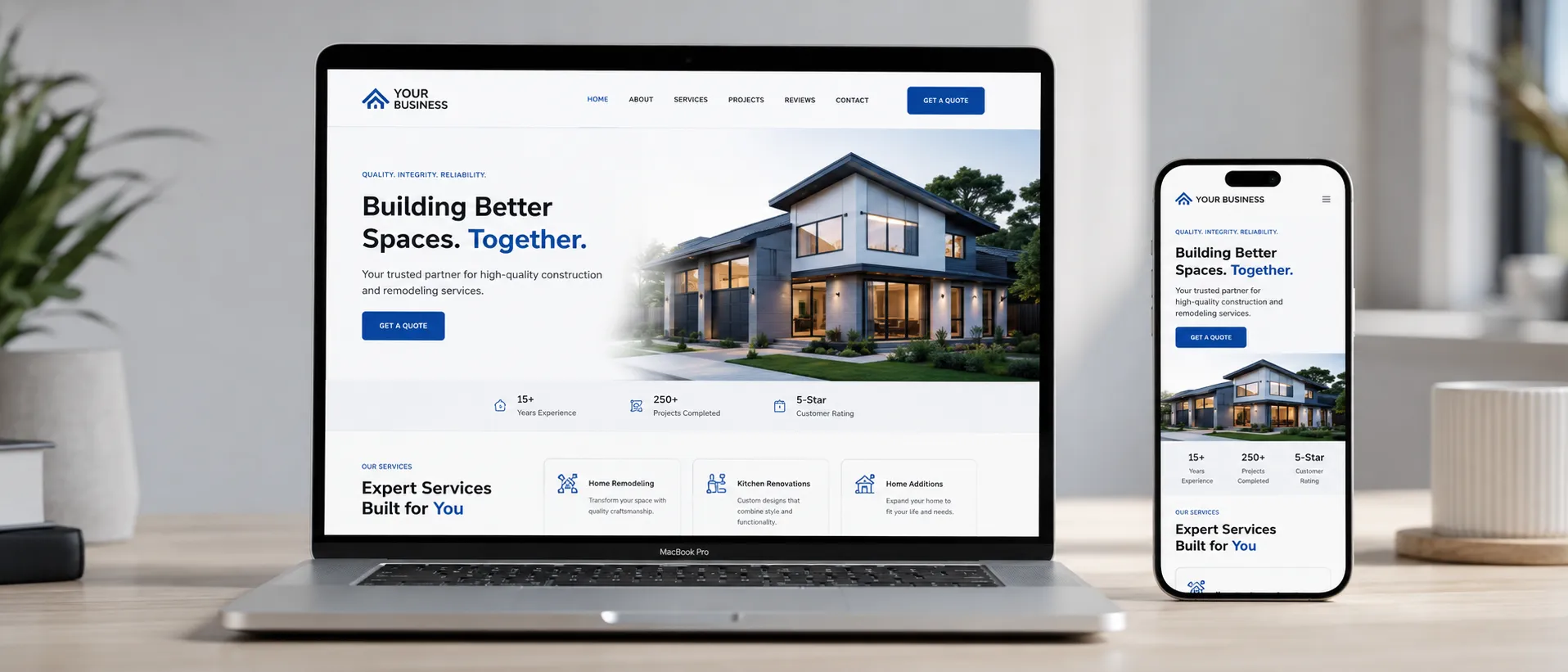
Contractors are often sold websites with long feature lists. Most of those features sound impressive in a proposal but do little to help a customer choose who to call.
A useful contractor website can be simple. It needs to answer the right questions, show real proof and make contact easy from any device.
A home page that explains the business quickly
Your home page should cover the basics in a few seconds: what you do, where you work, why people choose you and how to get an estimate.
It should also point visitors toward your main services, recent work and contact details without making them search through a crowded menu.
A clear page for each main service
You do not need a separate page for every small task. Start with the services that bring in the right jobs. A roofer might need pages for roof replacement, repairs and storm damage. A remodeler may focus on kitchens, bathrooms and additions.
Each page should explain what the service includes, who it is for and what the next step looks like.
Real work and customer proof
A project gallery does not need hundreds of photos. Ten strong examples with short descriptions can be enough to show the quality and range of your work.
Add reviews that match the services you want to sell. A kitchen remodel review belongs close to the kitchen remodel work, not hidden in a general slider at the bottom of the site.
An about page with a reason to care
Customers do not need your full life story. They do want to know who runs the business, how long you have served the area and what working with your company is like.
Use a real photo. Write the page the way you would introduce the company during a first visit.
A contact route that works every time
Include a working phone number, a short form and the area you serve. If you have set office hours or a usual reply time, say so.
Test the form after every website update. A beautiful contact page is useless if the message never reaches you.
Fast loading and solid mobile use
People should not wait for oversized photos or fight with a desktop layout squeezed onto a phone. Pages need to load quickly, text needs to be readable and buttons need enough room to tap.
These are basic parts of a working site, not paid extras.
Ownership and access
Know who owns the domain name, where the site is hosted and who can update it. Keep the logins in a safe place. If you stop working with a website provider, your business should not lose its address or its content.
Ask about this before the project starts, not after the site is finished.
What most contractors can skip
- A huge site with pages that repeat the same thing.
- Fancy movement that slows the page or hides information.
- Stock photos pretending to be your crew or your work.
- A blog you do not have time to keep useful.
- Tools and subscriptions with no clear purpose.
- Claims about rankings, leads or sales that nobody can promise.
Start with the pages and proof your customers need. Add something new only when it has a clear job. That keeps the site easier to use, easier to manage and easier to trust.
Planning a new site or replacing an old one?
We can review what you have and recommend the pages your contracting business needs without padding the project with extras.
Get My Free Evaluation